
Local SEO mastery in 2026: the 40+ relevance signals Google actually uses
A plumber I've worked with for years called me up frustrated. He'd done everything the "checklist" SEOs told him to do. Google Business Profile filled out, hours correct, services tagged, NAP perfect across 60 citations, steady five-star reviews. And the guy two blocks over, with a half-finished profile and a website built in 2018, was eating his lunch in the map pack. Sound familiar? It's the most common call I get from roofers, HVAC owners, and plumbers in 2026. The reason it keeps happening is simple. Google's local algorithm uses 40+ relevance signals, and most home service businesses are only touching 20% of them.
The local relevance gap (and why basic GBP work hit a ceiling)
Here's the thing. Google stopped grading local SEO on a checklist a long time ago. The stuff most agencies still sell as "local SEO" (claim the listing, fix the NAP, get a few reviews, embed a map) was the whole game in 2014. In 2026 it's the price of admission. It gets you eligible to rank. It does not get you ranked.
What's actually deciding the map pack now is a layered evaluation of how embedded your business really is in a specific area. Geographic proof, behavioral signals from real users, the content inside your reviews (not just the star rating), community link patterns, deep neighborhood-level content, and a stack of structured data that ties it all together. Proximity still matters. It's just not enough by itself. A 1.2-mile competitor with weak signals is now getting beaten by a 3-mile competitor with strong ones, and Google is more comfortable with that swap than ever.
Pile on the AI Overviews shift and the answer engines, and the gap widens fast. ChatGPT, Gemini, and Perplexity all want one thing when a homeowner asks "who should I call for a leaking water heater in Round Rock." They want the most authoritative entity for that exact spot on the map. That's a higher bar than ranking ninth in a long list of blue links, and it's exactly what AEO (answer engine optimization) is built to solve.
The 7 signal categories that actually move local rankings
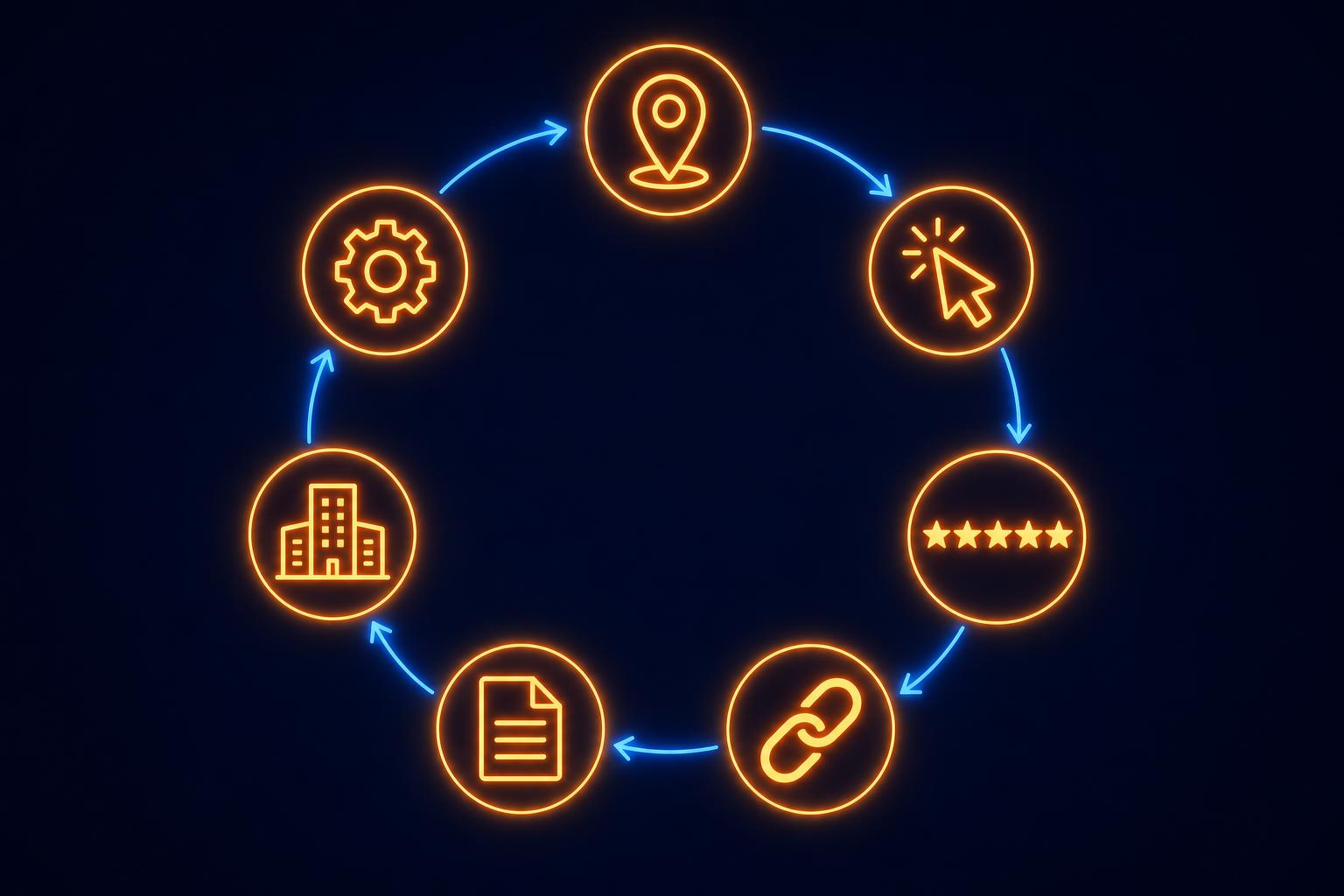
I group the 40+ signals into seven categories. None of them work in isolation. They feed each other. A strong review with neighborhood mentions strengthens your geographic footprint. Good geographic content earns better engagement. Better engagement attracts more reviews. It's a flywheel, and most home service businesses never get it spinning because they only push on one or two spokes.
1. Geographic footprint and proximity signals
Proximity is the foundation, but proximity isn't just the pin on your GBP. It's the layered evidence that you actually work in the area you claim to serve. A roofer in Plano should have neighborhood pages for West Plano, Legacy West, the area around Preston Hollow, and the Frisco border. Not five copies of the same page with the neighborhood name swapped in. Real content. Real photos. Real specifics. (This is what a real location page looks like, not the template junk most agencies ship.)
For trades, the easiest wins look like this:
- Geotagged before/after photos (most phone cameras embed this automatically, don't strip the EXIF).
- Service area pages that name actual streets, subdivisions, and HOAs you work in.
- Project galleries organized by neighborhood, not by service type.
- A "recently completed" feed that shows the city/neighborhood next to each job.
- Response time data per zone if you can pull it from your CRM (more on this in section 7).
You know what makes this work? Specificity Google can verify against other sources. If your site says you work in Cedar Park and your Google reviews mention Cedar Park and your project photos are tagged in Cedar Park, that's three corroborating signals. If your site just says "serving Greater Austin" and nothing else, Google has nothing to verify. That's the whole point of dedicated local SEO work.
2. Behavioral engagement patterns
This is the category most home service owners completely miss. Google watches what users do after they see you in the results. Did they click? Did they call? How long was the call? Did they ask for directions? Did they come back to your site a week later? Every one of those interactions is a signal, and the modern local algorithm leans on them hard.
Practical fixes for plumbers, roofers, and HVAC sites:
- Tap-to-call buttons above the fold on every page (not just the home page).
- A real local phone number, not a tracking number that masks your area code on caller ID.
- Embedded map with parking notes for the office (yes, even for trade businesses, GBP rewards it).
- Neighborhood-specific landing pages with their own offers ("$50 off for Pflugerville residents" beats a generic "$50 off coupon" because it earns engagement from the right zip codes).
- GA4 set up with phone call conversions imported from CallRail or similar, plus UTM tagging on every GBP link.
Engagement isn't a "soft" signal anymore. It's first-class. If your map pack listing gets a 3% click-through and the guy ranking below you gets 9%, you're not going to hold that position long.
3. The review ecosystem (beyond stars and volume)
Most folks I talk to treat reviews like a scoreboard. 200 reviews at 4.9 stars, done. Google reads them as content. The NLP inside the local algorithm pulls out service mentions, neighborhood names, problem types, and sentiment. A review that says "Mike came out to our house in East Nashville on a Sunday for a burst water heater and was done in 90 minutes" is doing about ten different jobs for your rankings. A review that says "great service, highly recommend" is doing one.
What I push every client to do:
- Train techs to ask for reviews in person at the end of the job, with a tablet or QR code (highest conversion rate by a mile).
- Coach customers gently: "If you mention the neighborhood and what we fixed, it really helps other neighbors find us."
- Respond to every review within 24 hours, with the customer's first name and a reference to the actual job (not "thanks for your business!").
- Keep a steady drip of new reviews. 4 reviews a week beats 40 reviews in one month and then nothing for two months.
- Don't ignore the other platforms. Yelp, BBB, and Angi reviews feed entity signals too, even if you hate Yelp.
Quick gut check: when's the last time you actually read your last 20 reviews to see how many mentioned a neighborhood, a service, or a specific problem? If the answer is "never," that's your week one project.
4. Local link ecosystem and community integration
Forget the generic "high DA" backlink list your last SEO sold you. For trade businesses, the links that move the needle are the ones a competitor in another city literally cannot get. Chamber of Commerce. Local nonprofits. Little League sponsorships. The neighborhood blog that covers your area. The HOA newsletter. A quote in the local paper after a hailstorm. Those are the links that build "neighborhood authority" and most of them cost you nothing but a phone call.
A few tactics that consistently work for plumbers, roofers, and HVAC owners:
- Sponsor one school team or youth sports league per year. Most include a website link.
- Partner with a complementary trade. Roofers and gutter installers. Plumbers and remodelers. HVAC and insulation. Cross-link the recommended-partners pages.
- Pitch the local TV station after major weather. After a freeze, plumbers get on the news every time. After a hailstorm, roofers do. Be the first one to email.
- Write one solid expert guide for a neighborhood blog or community Facebook group admin who has a website. "What [City] homeowners need to know before a roof replacement" gets picked up because it's actually useful.
5. Content localization depth
Surface content tells Google you exist. Deep content tells Google you belong there. Most trade websites have a "Services" page with eight bullets and a "Service Areas" page with a list of city names. That's the floor, not the ceiling.
What "deep" actually looks like:
- An HVAC company in Tampa writing about why heat pumps struggle in coastal humidity and which units handle salt air best.
- A roofer in Dallas explaining why hail in Frisco patterns differently than hail in Plano and how that affects insurance claims.
- A plumber in Houston writing about hard water mineral content by zip code and which water softeners actually handle Gulf Coast water.
- A roofer in a historic district explaining permits and HOA rules specific to that neighborhood.
This content does two things. It builds topical authority at the neighborhood level (which feeds E-E-A-T for the broader local entity). And it tends to earn the kind of branded and long-tail searches AI engines love to cite.
6. Multi-location consistency (if you have more than one shop)
If you've got two or three locations, this one's a trap most owners fall into. They build one master site, swap the city name on a template, and use the same phone number with extensions. Google sees duplicate content, weak entity separation, and ranks none of the locations well. I wrote a whole piece on the right way to handle local SEO for multiple locations if you want to go deeper.
The rule is simple. Each location gets its own GBP, its own unique phone number, its own page on the site with truly unique content (different photos, different team bios, different reviews embedded, different local references), and ideally its own physical address. If you can swing a separate domain for the second location, even better, but the unique-page approach works well if you stay disciplined about avoiding duplicate copy.
7. Technical signals: schema markup and GBP posts
This is the boring stuff that quietly separates the top three from everyone else. Implement LocalBusiness schema. Layer in ServiceArea, AggregateRating, and Review schema. Mark up your service pages with specific neighborhoods and ZIPs in the areaServed field. Don't just paste a generic schema generator output, customize it.
And for the love of everything, use Google Business Profile posts. Most home service owners post once when they set up the profile and never again. A weekly post (a finished job, a seasonal tip, an offer for a specific zip code) is one of the cheapest map pack signals you can produce in 2026. It also feeds the AI engines, which scrape GBP heavily when they pick local entities to cite.
A 90-day implementation roadmap
You can't do all of this at once. Trying will burn you out and you'll quit by month two. Here's how I sequence it for trade clients:
Phase 1, weeks 1 to 4: Foundation
- Full GBP audit: services, attributes, hours, photos (add 10 fresh ones), Q&A.
- Schema implementation across the site.
- Citation cleanup, kill duplicates on Yelp, BBB, Angi.
- Set up GA4 + call tracking + UTM tagging properly.
- Review your last 50 reviews for neighborhood mentions, identify gaps.
Phase 2, months 1 to 3: Content and engagement
- Build 4 to 8 neighborhood pages with unique copy and real photos.
- Launch the review request system (tablet at the truck, scripted ask).
- Start weekly GBP posts.
- Add tap-to-call and neighborhood offers above the fold.
- Write 2 deep-content articles tied to local conditions.
Phase 3, ongoing: Community and authority
- One community link or sponsorship per quarter.
- One expert quote or guest post per quarter on a local site.
- Weekly GBP posts, never stop.
- Quarterly content refresh on your top 5 neighborhood pages.
- Monthly review of map pack rankings by zip code.
KPIs that actually matter
- Map pack visibility by zip code (not just one ranking number). Use a grid tool, not a single check from your office Wi-Fi.
- Click-to-call conversions from GBP and from the site, tracked separately.
- Direction requests trend in GBP insights.
- Review velocity and review content (new reviews per week + percentage mentioning a neighborhood or specific service).
- Branded search volume in Search Console (people typing your actual brand name).
- AI citation tracking if you can swing it. There are tools now that watch whether ChatGPT, Perplexity, and Gemini mention your brand in relevant local queries.

Common pitfalls that quietly kill rankings
- Stuffing the GBP name with keywords. "ABC Plumbing - Drain Cleaning, Water Heaters, Emergency Plumber Houston" is a suspension waiting to happen. Use the legal name. (And if you're already suspended, here's the full recovery checklist.)
- Fake addresses or virtual offices. Google's verification gets stricter every year. Real-world physical checks happen.
- Template-spamming city pages. 50 city pages that all read the same will get demoted, not ranked.
- Ignoring mobile UX. Most home service searches are on a phone. Slow site, tiny phone numbers, no tap-to-call, you lose. If your site is more than three years old, it's probably time for a conversion-focused rebuild.
- Buying review bursts. 40 reviews in a week followed by silence looks fake, because it is.
- Not adapting to AI search. The traffic shift is already happening. If you're not building entity signals now, you'll be invisible to half your future leads.
If your current SEO only talks about GBP and reviews
They're working from a 2018 playbook. That stuff matters, but it's category one of seven. You're paying for 14% of the work and wondering why you're not winning. Get a second opinion before you renew that contract.
Future-proofing: where this is all heading
The trend line is clear. AI Overviews keep eating the top of the SERP. Zero-click searches keep climbing. Privacy changes keep stripping out the easy behavioral data. The businesses that survive all three are the ones with deep, verifiable, community-rooted local authority. You can't fake your way through any of that with a $300/month "local SEO package." You build it the way you'd build a real reputation in your neighborhood, one job, one review, one community connection at a time. The web version is just a mirror of the offline version.
That's the part most agencies don't want to say out loud, because it doesn't fit on a slick proposal. But it's the truth, and it's why Stuart McHenry Consulting only works with home service companies that are ready to play the long game. The flywheel takes 90 days to start moving and 12 months to dominate. Once it's moving, it's almost impossible for a competitor to catch you, because half the signals are anchored in the real world.
The quick-audit checklist
If you only do one thing this week, run through this checklist on a yellow notepad and score yourself 1 to 5 on each:
- Neighborhood-level content with real specifics
- Tap-to-call + call tracking with conversions imported to GA4
- Steady weekly review velocity with neighborhood mentions
- At least 3 local community links earned in the last year
- Deep content tied to local conditions (weather, water, building stock)
- Clean multi-location separation if you have more than one shop
- Full schema markup + weekly GBP posts
Anything under a 3? That's where you start. Don't move on until it's at least a 4.
Send me your website and your city and I'll tell you which of the 7 categories you're already strong in and which ones are dragging your rankings down. Straight answer, no sales pitch.
Get a free local SEO audit